
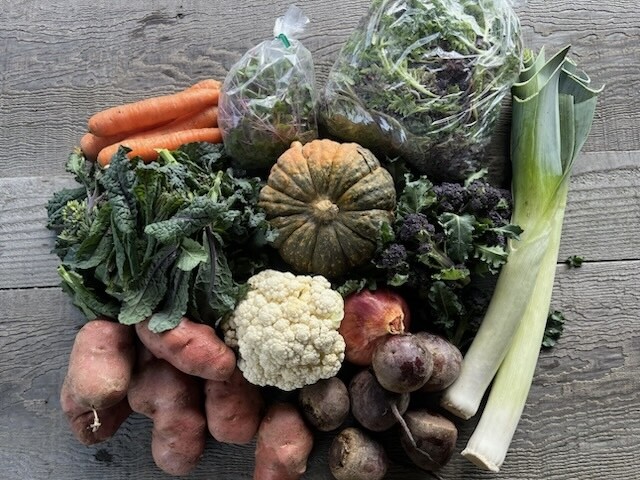
In This Week's Winter Share:
- Red Potatoes
- Red Beets
- Shallots
- Leeks
- Purple Sprouting Broccoli
- Lacinato Raab
- Carrots
- Radish Microgreens
- Winter Lettuce Mix
- Tetsukabuto Winter Squash
On Rotation:
- Winter Cauliflower
Apologies for the late send on this week's newsletter. We are battling a whitefly infestation in our propagation greenhouse and my entire day yesterday was spent combatting and trying to outsmart little soft-bodied invertebrates! We have unfortunately lost 120 trays of newly-seeded onions, leeks and shallots to the little buggers, so are having to start over in that department - no small setback in terms of seed cost, labor, potting soil and limited greenhouse space. Increased pest pressure is one of the unfortunate side effects of such an unusually warm winter - lots of pests that would normally die in cold weather are having a mid-winter heyday instead, adding some new grey hairs to my head :).
When I finally got home in the dark last night, instead of writing the newsletter I cooked a new recipe from the New York Times Cooking App. I recommend it for an easy, quick, weeknight sheet-pan dinner that uses your Tetsu squash and Lacinato raab this week: Sheet Pan Coconut Curry with Squash and Tofu
Also in the Valley Flora Headlines: 2026 CSA Sign-Ups are Underway!
Spots are going fast, so if you're interested in grabbing a CSA share for the upcoming June-December season, don't delay. You can learn more about our CSA here, and you can sign up for the season here!
Update on HB 4153, the "Farm Store Bill"
First off, thank you to everyone for being so engaged around this bill and sending letters, calling the governor and legislators, and voicing your concerns to Salem! The bill has been amended, but unfortunately those changes don't address some of the core problems in the bill, namely sacrificing Oregon's world-class farmland to multi-use retail, hospitality, and entertainment development. Oregon has some of the most forward-thinking land use laws in the country, including exclusive farm use (EFU) designations, which are intended to protect our working landscape for farming and agriculture for the long haul. This bill deals a big blow to that and would weaken Oregon's ability to produce food, fiber and forage overall.
Indeed, Valley Flora would stand to gain from this law if we wanted to convert our farm fields into a wedding venue or corn maze and build a 10,000 square foot mini-mall in the flood plain where our farmstands currently sits, all of which would be allowed and which is probably far more profitable than growing potatoes. But what would our community eat if we did that?
Yes, farming is hard (see whitefly sob story above), and no farming does not make you rich. But if you have the privilege of owning prime, irreplaceable EFU land, with that should come some guardrails to protect that farmland for generations to come. Our visionary land use laws are why Oregon looks different. Travel north, south, or east into any other state and notice the sprawl, the fragmentation of farmland, so much more glaring than it is here. We will always have to fight to protect it, because obviously there is great financial gain to be had by converting farmland to non-farm uses like housing developments, or "farm-adjacent" agritourism uses like those proposed in HB 4153. But at the end of the day none of that will feed us (unless kettle corn and donuts are what you have in mind for dinner).
Over 1,500 people testified about HB 4153, 70% of whom were OPPOSED, but right now the bill is still moving forward. This is not great news, but it isn't over yet. If you haven't already done so, consider sending a letter to your legislators (this link makes it easy). Some key talking points:
- NO to shifting agriculture to the back burner and allowing commercial nonfarm activities as a primary use on farmland.
- NO to incentivizing nonfarm commercial development on less expensive, lower taxed farmland.
- NO to ignoring commercial development impacts on neighboring farms.
- NO to passing a bad bill now and potentially spending $1 million or more to fix it later (due to Measure 56).
- YES to farmer-owned and operated stores, restaurants, and event venues inside our cities and small towns.
- YES to direct sales for farmers under existing farm stand provisions that require farming to remain the predominant use.
- YES to listening to the will of Oregonians: 70% of people who submitted testimony earlier this month were against HB 4153. This represents over 1,000 farmers and their supporters from all across the state who do NOT want this bill to pass.
I have so much appreciation for all of you - for caring about these issues, and for supporting family farms and wise agricultural policy in our state. Thank you, and enjoy your VEGETABLES (grown on Floras Creek on prime EFU farmland)!
