
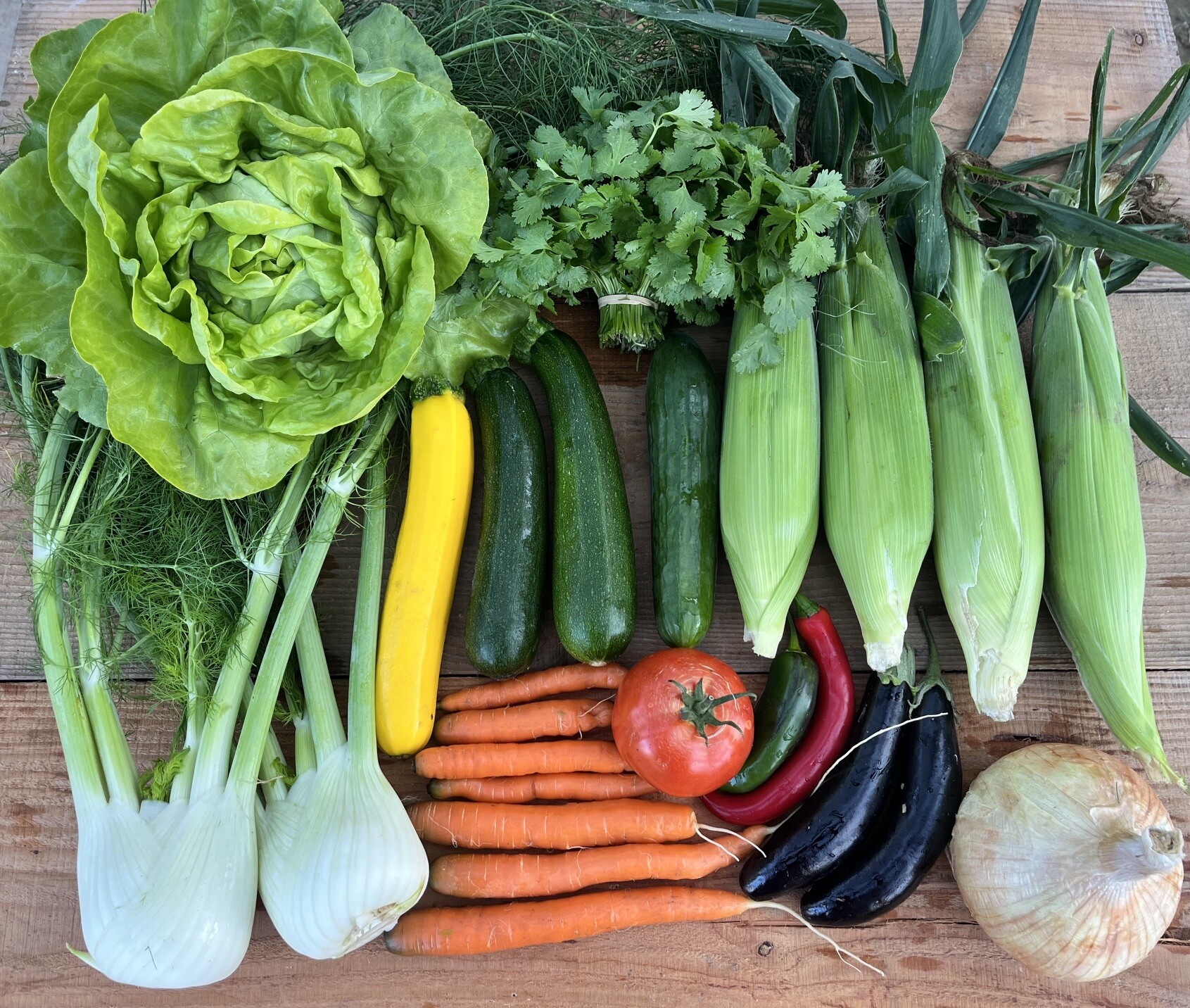
In the CSA Share this Week:
- Fennel
- Zucchini
- Carrots
- Tomatoes
- Eggplant
- Hot Peppers
- Walla Walla Sweet Onions
- Cilantro
- Lettuce
- Persian Cukes
On Rotation:
- Sweet Corn
10 for a Buck: Unpacking the True Cost of Food with One All-American Vegetable
Last week a farmstand customer complained about the price of Valley Flora sweet corn. He put some emphasis on it: “I remember when corn was 10 for a buck.”
Corn is one of the most iconic American vegetables, so woven into the fabric of our culture that we eat corn on the cob for Thanksgiving - in November, when it’s absolutely not in season. And if the comment at the farmstand is any sign, there's an expectation deep down in some of us that cheap corn is a backyard BBQ birthright in this country, no matter how inflationarily outdated that 10 for $1 sweet corn memory is.
Valley Flora sweet corn costs $1.75/ear at the farmstand, the same price it’s been for the past two or three years. I was headed into the corn patch with a bushel-sized harvest backpack strapped to my back when a crewmate offhandedly relayed this 10 for a buck customer encounter. I had at least three sweaty hours ahead of me lugging upwards of 700 ears of corn out of the field for our Saturday farmstand, CSA shares and wholesale orders. This is at the near-end of what has been the most arduous year of corn production we’ve ever had (more on that later), after a long summer grind of 12-14 hour days, in a volatile and radically inflationary year (Iran, Strait of Hormuz, Ukraine, tariffs). A year when I should have raised the price on everything we grow but didn’t because I feel so bad about how unaffordable the world has become for the average consumer (never mind that farmers are also consumers, more on that later as well).
I’m not one to get mad very often. I’m a pretty cheerful, roll-with-the-punches kinda gal and when I am angry my family jokes that it’s a “gosh, golly, I’m piping hot with anger” kind of mad (you gotta say it in a fluttery 1950s housewife voice, laced with a little wide-eyed surprise). Rage simply isn’t my default emotion, but in that moment halfway down the rows of corn something unexpectedly snapped in me. Yup, I was suddenly piping hot with anger. It was a maelstrom of thoughts that boiled up like a tornado rearing out of the corn-studded plains, but at core it was frustration about a single, fundamental fact: that even as an organic farmer at the edge of the continent working to feed a wonderful, supportive, rural community, I still have to go toe to toe with a cheap, broken, conventional food system and justify the price of our corn, even though it’s apples to oranges.
Fortunately I had three hours of hard corn-picking labor to gnash my teeth over the comment – hauling one 70-pound-backpack-after-another to the truck – each load weighing more than half my body weight. The good thing about physical labor is that it helps the glitter settle so you can think straight, and on that particular morning I realized I had forgotten something: that most people don’t know much about growing sweet corn, or about farming in general – things that I take for granted. Why would they when less than 2% of Americans are farmers anymore, leaving 98% of the population somewhere on the spectrum between “no clue, don’t care” to wild over-romanticization of the agrarian myth?
This essay is going to try to shed some light on it. It’s about how an offhand remark about the price of our sweet corn can inspire a razor-sharp look at the reality of corn production, alongside a slew of observations about the mainstream food system and the economic system that drives it. At the end of the day, this piece is about two very different agricultural paradigms: conventional versus organic, industrial versus human-scale, global versus community-based - but how we’re all in the same economic pressure-cooker together that's pushing both farmers and consumers to the brink.
But before we can look at the big picture we have to drill down at ground level: you need to first understand what it takes to grow an ear of corn on our farm. I’ll say it straight: reality is a far cry from 10 for a buck. Our goal at Valley Flora is to provide steady, good value: high quality at a fair price. Our bunches of chard might cost a little more than the ones in the produce aisle at times, but they’re also organic, twice as big and were picked the day before. There's an important thing to remember: there’s a difference between value and price. On the flip side, there are also times when I go on a spy mission to the supermarket and am shocked by how high the prices are, and the chard is sad and puny to boot. There’s a lot of whipsawing in the mainstream market, which isn’t our thing. We tend to set a price and stick to it, probably to a fault.
For the farm to be viable long-term, what we charge has to cover our fixed costs (equipment, utilities, infrastructure, lease, maintenance, insurance, etc etc etc), our variable costs (what it costs to grow each specific crop each season), and leave us with some profit. There’s a rough golden rule that each of those three buckets – fixed costs, variable costs and profit – should constitute about 1/3 of the price of any given crop we grow. The burning question we’re setting out to answer here is if our $1.75/ear corn is meeting the mark.
I’ll warn you: this is not a short story, and it’s a little bit of a geeky one. It takes a lot of steps to put an ear of corn on your plate, and a lot of number crunching to figure out what those steps cost along the way. I hope you’ll stick with me, because the story of sweet corn is the story of pretty much all the food we grow, and the food we grow is different from the vast majority of food grown in this country. Also, I burned some midnight oil to pen this puppy and would love to hope that you – or somebody out there among the 98% - might be curious.
So here we go: Sweet Corn Econ 101, a reality tour.
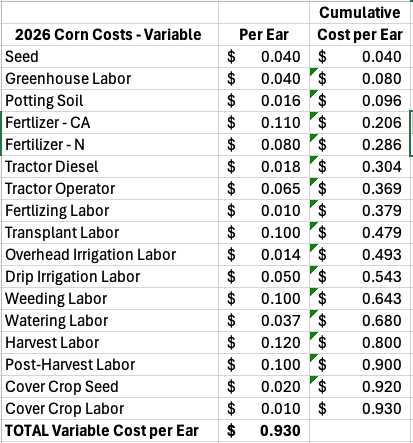
p.s. For ongoing reference, and to make it easier to follow along, I’ve pasted in a spreadsheet that breaks down our 2026 variable cost of production for sweet corn, here:
No matter what kind of farm, in the beginning there’s a bag of seed. On our farm we mainly grow an organic sweet corn variety called Allure, a big-eared bi-color with great vigor and delicious flavor. It’s been our go-to sweet corn for a decade and is relatively high yielding. (Sidebar in case you’ve never grown a patch of sweet corn: “high yielding” is a relative term. Sweet corn is a space hog and a nitrogen guzzler and a single 6’ stalk often only produces one saleable ear of corn. So when we say “high yielding” we don’t mean compared to a potato plant, which can pump out twice as many calories as a corn plant, just compared to all the other corn varieties out there. For the purpose of all the math that I’m about to throw at you, we’re going to use the assumption that one corn plant yields one saleable ear of corn. Sometimes it’s more, sometimes it’s less, and that’s the beauty of an average.)
In our case, we source certified organic Allure seed from one of our trusted seed companies. It’s not cheap: about 2 cents per seed (if you’re doing the math on 10 for a buck, we’re already 2 cents into our 10 cent ear of corn).
An important thing to know: Our climate is not ideal for sweet corn, specifically for direct seeding it into the ground, which is pretty much how all corn is planted around the world. Corn needs warm soil to germinate, and this is foggy, coastal Oregon, not Kansas. The optimal soil temperature is 85-90 degrees, which never happens in our valley, and certainly not in May when we need to start planting corn. So, we do a crazy, expensive thing to have sweet corn success: we transplant it instead of direct sowing. Starting the seeds in our greenhouse guarantees more reliable germination and gives the plants a 10-day jumpstart in the greenhouse. We put each individual seed into a cell in a 144-cell tray, by hand, 8 trays per succession, one succession per week, 5 successions in total. We seed about 20% more than the number of plants we need in the field, in case not every seed sprouts. It takes one person around 60 minutes to fill 8 trays, plant the seeds, water them in and load the trays into our germ chamber (a dark, steamy insulated box that stays a constant 70 degrees, 24/7 = great for germinating most seeds). This system is labor intensive compared to pushing a seeder down a row in the field and getting a 220’ bed planted in less than a minute (Valley Flora style), but unfathomably so when you could drive a monster-tractor across the landscape and seed 48 rows in one pass (Iowa - “corn capital of the world” - style).
This difference points up the cost of labor on a human-scale organic farm, which is by far our biggest expense, and getting bigger every year. There is no Valley Flora without our crew and we do our best to give our employees regular raises, bonuses, and pay them an overall living wage. All of them could make more money doing something else, so the fact that many of them have stayed with us for 5, 7, even 16 years is testament to their passion and commitment to this farm. We’re lucky to have this team and my number one budget priority is paying them more because they profoundly deserve it.
The average cost per hour for our crew this year is $21.75/hour, including workers comp insurance, bonuses and state and federal taxes. My wage is included in that average because I work alongside the crew in the field and run the business from the office (including sometimes writing impassioned newsletters in the middle of the night). I’m salaried at $18,000 per year, which means my take home is $1,319.86 each month. I’ve got an undergraduate degree from Stanford, a master’s degree, and I’ve been farming for 25 years. At that salary level, I make less each month than anyone on the crew, but the hope is that the farm will turn a profit and I can pay myself more at the end of the year and invest something back into the farm in the form of improvements and upgrades. It’s always a crapshoot.
At a rate of $21.75/hour, our greenhouse seeding labor works out to about $0.02/seedling, and we’re assuming one seedling becomes one plant that yields one ear of corn on the cob. The potting soil to fill eight 144-celltrays costs about $8.75, or $0.008/ear.
After two days in the germ chamber the trays get moved to the heat table and spend another week there getting daily water until their root system is sufficiently developed. This is more labor but it’s hard to tease out exactly how much because we’re often shuffling lots of trays to different places in the greenhouse and watering things throughout the day as needed. We’re gonna ignore this bit of fuzzy labor math and dump it in our bucket of fixed costs, because after all, farmers are expert at not paying themselves for their time.
Sprouting corn seeds is a made-for-kindergarten activity requiring practically zero patience and serving up almost instant gratification: the seed is large and easy to plant compared to stubbornly spear-shaped little lettuce seeds or tiny runaway brassica bb’s or microscopic celery. It germinates within a couple days, and then the seedlings grow at a breakneck pace. Most things spend at least four weeks in our propagation greenhouse before being transplanted outdoors but corn only needs 10 days before its taproot is pushing through the tray and begging for the great outdoors.
We’ve never had issues with corn germ but this year we noticed a problem immediately: we were only getting 50% germination in our trays instead of the usual 90-100%. That meant we had to reseed the first two successions entirely and then double our tray numbers for the remainder of the successions, effectively doubling our seed cost from 2 cents to 4 cents per ear and doubling our labor cost and potting soil cost during the greenhouse phase.
Taking into account our shoddy seed lot (which was ultimately recalled as a seed crop failure by the seed company), we’re almost at $0.10/ear:
- Seed: $0.04 ear
- Greenhouse labor: $0.04/ear
- Potting soil: $0.016/ear
- Total: $0.096/ear
You can see where this is trending and we haven’t even gotten to the field yet.
Planting: For five consecutive weeks starting in late May we plant 3 to 4 beds of corn every Thursday afternoon. To prep those beds requires 7 to 8 passes with the tractors, starting in March. The first pass happens with our 60hp Kubota (Big Betty) dragging the flail mower, which cuts and shreds the dense winter cover crop. The second pass happens shortly after with the little 32 hp Kubota (Wilma) to broadcast a custom blend of calcium, bonemeal and micronutrients to bring our pH and soil into balance for the season. That blend costs $0.11 per ear of corn. Pass #3 is with Big Betty and the spader to incorporate the cover crop, as is pass #4 to create a clean bed for transplanting. The fifth pass is with Wilma to mark the beds and establish our pathways. Once the crop is harvested in the fall, we pass over the spent corn with Big Betty and the flail mower again to chop the stalks, and then one to two more passes with Big Betty and the spader to incorporate the residue before seeding cover crop by mid-October. The cover crop gets rolled in behind Jack and Lily, our draft horses, with an antique horsedrawn cultipacker that I salvaged out of a blackberry thicket off an old ranch near Powers.
The cost of the equipment ($97,000 for both tractors, the flail mower and the spader) gets puts into the sprawling budget bucket called overhead, or fixed costs. But it takes diesel fuel to keep our tractors running and that’s a variable cost. And hoooo boy is it variable this year! This spring prices at the pump jumped to almost twice what they were last year, and at the start of this month diesel hit its highest peak on record - thanks in large part to the war in Iran, the Strait of Hormuz, and the war in Ukraine. Our tractors use about a gallon of fuel per working hour, and to make those 7 to 8 tractor passes throughout the season it takes about 2/3 gallons of diesel per bed, with 220 plants in each bed. We’ve been paying an average of $6/gallon so far this season = $4 of diesel per 220 plants = $0.018/ear in fuel alone, plus operator time ($21.75/hr x 0.66 hr = $14.36 divided by 220 plants = $0.065/ear).
But here’s where it starts getting labor-intensive: come Thursday afternoon, the crew heads out with the greenhouse trays to plant the corn. First the beds are spread with our organic nitrogen fertilizer blend, which costs $33.50/bag. We use a highly assimilable 13-0-0 nitrogen product called Pro-Natural that’s derived from feathermeal and bloodmeal. We make a precision application at the time of planting based on the crop. For instance, a bed of radishes gets half as much Pro-Natural as a bed of corn, because corn is a much heavier feeder than radishes. We don’t want to create nitrate pollution from excess fertilizer, or waste something so expensive (we pay 5.5 times more for organic fertilizer per pound of nitrogen than synthetic options like urea). Urea (46-0-0) is manufactured from natural gas and its high nitrogen content makes it the culprit behind extensive nitrate contamination in groundwater and surface water, particularly in places like Iowa where there’s a lot of industrial corn grown. Those nitrate levels are now being linked to the nation’s highest cancer rates and are causing a few Iowa politicians some major heartburn, pinched between Big Ag and the MAHA movement.
On our farm, each bed of corn gets half a bag of Pronatural = $16.75/220 plants = $0.08/ear, plus the labor to drag the spreader (approximately 6 minutes per bed at $21.75/hour = another penny per ear). Then we plant each seedling into the 220’ row by hand on one foot spacing = 220 plants per bed. This is bent-over work that requires full-body strength and endurance. On average it usually takes 15 minutes for two experienced people to plant a single-line bed, with one person dropping starts and the other troweling them into the ground (0.25 hour x 2 people = 0.5 labor hours, $21.75/hour = $10.88/220 plants = $0.049/ear). That’s a slightly optimistic figure because we’re always training newbies on the crew who haven’t developed the strength and skill to move that fast yet. And this year our weak seed lot meant we had weak seedlings, which nearly doubled our transplanting time because we had to be extremely delicate handling the plants, and had to replant a lot of starts that died in the field. That put our transplanting labor cost at $0.10/ear.
At this point our direct cost of production for an ear of corn is $0.48 and has officially eclipsed the price of grocery store corn as advertised in Port Orford last week when I drove by on my way to a haircut: 3 for $1. I read their reader board aloud to my dog - the only person in the backseat – and mused, “how…..?!” This was just days before the 10 for a $1 comment at the farmstand, so the 3 for $1 sign was like a little pile of dry tinder poised perfectly-ready for the 10 for a buck incendiary spark. The subsequent firestorm of typing has now become a 5,674-word essay about corn, and I'm wondering, are you still with me?
We’re at forty-eight cents an ear and we haven’t even watered it, weeded it, hilled it, picked it or packed it. In fact, there are still three more months to go before there’s any corn on the cob at all.
Assuming there isn’t widespread mortality, we should end up with 16 rows of corn and just over 3500 corn plants in the field once we’re done transplanting all the successions. This year our success rate wasn’t so great due to the weak plants that came out of the greenhouse. But once the seedlings take off, the field-growing phase of sweet corn is a time-lapse marvel on steroids, without the actual need for time-lapse: you could pretty much sit there and watch the stuff grow before your very eyes, if sitting still was an option in July. Corn is a grass, and today’s modern corn varieties are descended from a wild relative known as teosinte. Over the millennia Mesoamericans selected and bred teosinte for bigger and fatter seed kernels, to the point that modern-day ears of corn appear ridiculously cartoonish compared to their wispy ancestor. But a grass it still is, and like some tropical jungle superweed it goes gangbusters during the warm summer months. The plants double in size every week and even in our relatively cool climate they’ve never missed the “knee high by fourth of July” mark.
But that fast growth also poses some logistical challenges with irrigation and cultivation. We start irrigating corn with overhead sprinklers to make sure our fragile seedlings get a good start with plenty of water. That means setting up pipe (0.5 labor hours per line x 2 lines x $25/hour = $25 = $0.007/plant). But within six weeks the corn is reaching past our tallest sprinklers, which means we have to remove the pipe (0.5 labor hours per line x 2 lines x $25/hour = $25 = another $0.007/plant) and switch the entire corn field over to drip irrigation. Drip is far more efficient and is fantastic for water conservation but it’s time-consuming to set up. Laying out headers, pulling 16 lines of drip tape, flushing and capping the lines, and repairing any leaks takes about four labor hours from start to finish = $87 in labor = $0.025/plant. And then you have to roll it all up when the corn crop is done = another 4 hours of labor, $0.025/plant.
We’re at $0.543/ear.
Along the way we pull weeds like good little organic farmers because organic farmers don’t spray toxic herbicides to kill things. Herbicides like glyphosate nuke pollinators, contaminate waterways, and are linked to cancer, none of which is included in the price of 3 for $1 conventional corn, and certainly not 10 for $1 corn. Like the cancer-causing nitrate pollution from excessive use of chemical fertilizers, these are all “externalized costs:” the costs of an economic activity that isn’t borne by the producer or the consumer and is passed on to society or the environment at large. Cheap conventional corn doesn’t include the price of cancer; the extinction of a species; the exploitation of migrant farmworkers; the bankruptcy, or worse - suicide - of a family farmer caught in the price squeeze; the climate-changing greenhouse gases farted out by semi-trucks transporting food hundreds, sometimes thousands, of miles to market; the irreversible loss of topsoil; the collapse of ecosystems. That’s what’s behind the cheap, cheery curtain of the grocery store reader board. 3 for $1! The end of the world!
People and planet always end up footing the bill for externalized costs eventually though. It’s in the form of skyrocketing health care costs, the uptick in climate-induced natural disasters, the human/environmental/economic toll of a war being fought over fossil fuels and fertilizer; a family going hungry because a farmworker isn’t paid a living wage to toil in the fields to feed the rest of America.
Because we don’t spray herbicide, we do some toiling ourselves to keep the farm weed-free. We cultivate the rows mechanically with the horses and by hand with various hoes. Jack and Lily pull the straddle-row cultivator and hilling discs through the corn multiple times until it’s too tall to get through (4 hours x $21.75/teamster hour = $87, $87/3500 plants = $0.025/ear). The crew moves through the field a couple times with oscillating hoes to get the in-line weeds (12 labor hours x $21.75/hour = $261, $261/3500 plants = $0.075/plant).
And twice a week for 12 weeks we turn the irrigation on and off, which sometimes involves moving hoses, checking lines and fixing leaks: 0.5 labor hours per week x 12 weeks = 6 hours, 6 hours x $21.75/hour = $130.50, $130.50/3500 plants = $0.037/ear in watering labor.
Finally, mid-August rolls around and the ears on our first planting are finally ripe. In the case of corn, we can usually harvest and field pack around 300 ears per labor hour. But this year, we had a couple climate change curveballs that fundamentally changed the playing field: 1) a bizarrely warm winter that failed to kill off seasonal pest populations, including Helicoverpa zea, the nocturnal moth that’s known in its larval stage as corn earworm, and 2) a cute little hurricane that blew through the farm on September 2 and flattened our corn patch to the ground at peak harvest. Those two mini calamities have slowed the corn harvest down considerably, such that I’m bringing in about 180 ears of corn an hour instead of 300, which works out to 12 cents per ear in harvest labor. The ubiquitous presence of earworm means I have to check a lot more ears for damage, cull a higher percentage of the ears, and accept more imperfection (with the hope that our customers will understand). The early September storm turned the corn patch into a maze of maize - a literal field of criss-crossed pickup sticks. So instead of cruising upright down the rows, efficiently snapping ears and lobbing them over my shoulder into the backpack, I’m picking my way through an obstacle course, dropping into a power lunge, bending forward repeatedly to prop corn plants up and pry ears off the ground with 70 pounds on my back.
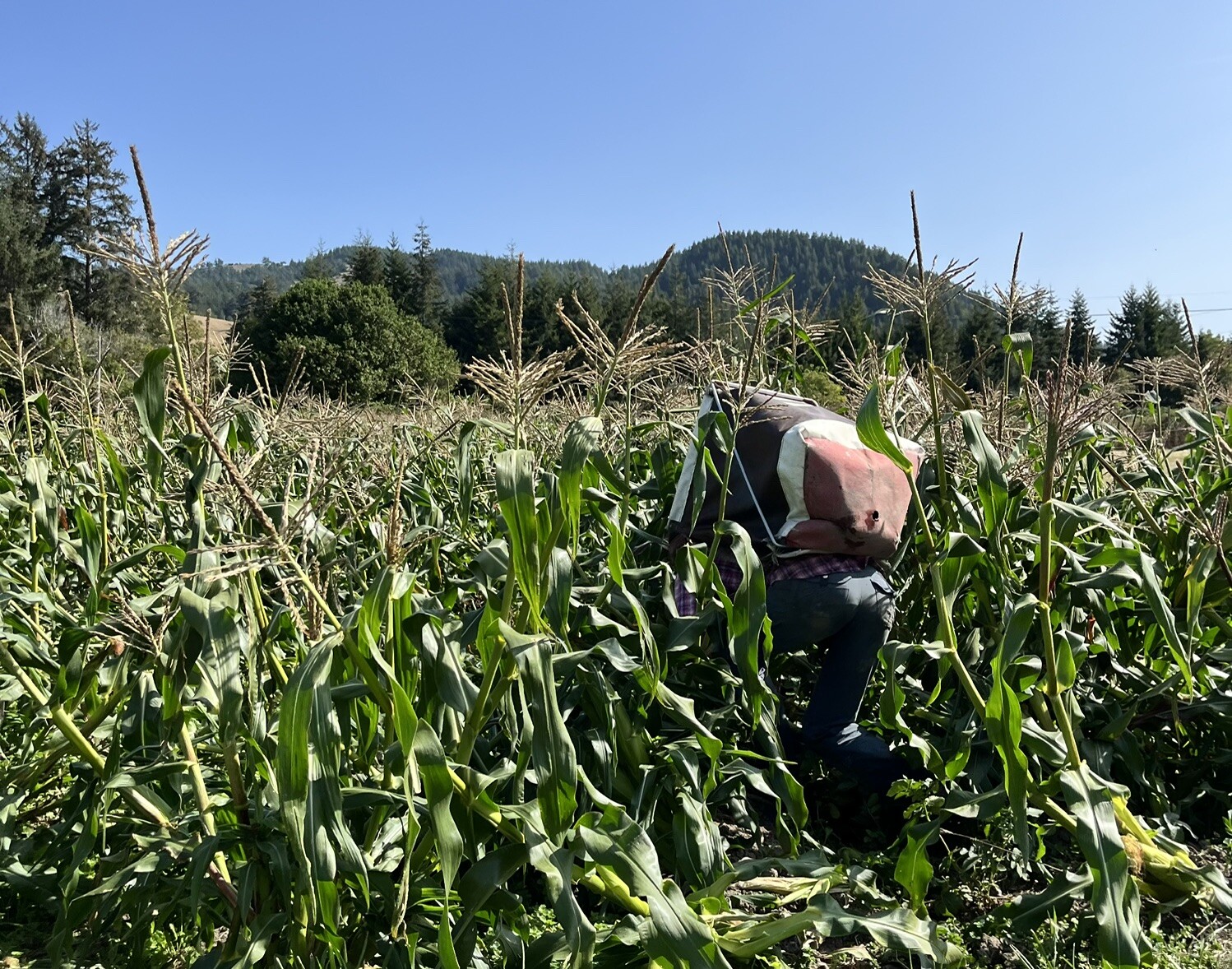
Normally I would have a partner in crime for corn harvest, another crewmate to wear the second backpack and help make short work of the harvest. But with the challenge of corn earworm quality control and the risk of injury from decidedly un-ergonomic blowdown corn, I won’t let anyone else into the corn patch this season.
No one can afford to get hurt, literally, because health insurance and health care are so expensive in the U.S. As a result, none of us have insurance. The reasons for out-of-control health care costs in this country are crazy-complex and I won’t pretend to have a full grasp of it, but it seems most experts agree that the prevalence of preventable chronic disease is one contributing factor. Diseases like obesity, heart disease, diabetes and cancer affect one in every two Americans and account for 90 cents of every dollar spent on health care in the U.S. (source: Partnership to Fight Chronic Disease). And coming full circle, a lot of these chronic diseases are rooted in our conventional, industrial food system – much of it underpinned by – you guessed it – corn (albeit the corn grown for processing rather than sweet corn). According to the World Health Organization, as much as 80 percent of premature heart disease, stroke and type 2 diabetes, and 40 percent of cancers could be avoided entirely if Americans steered clear of tobacco, ate healthier food and got more exercise.
At this point I want to pause and cheer for all you Valley Flora eaters who are undoubtedly following at least some of the WHO’s advice and making a difference in the chronic disease stats through diet. Wouldn’t it be great if there was also the political will to implement a more progressive tax code so that there was money in the coffers to support universal health care so that everyone, including the people who feed this country, could have peace of mind that an unforeseen medical emergency isn’t going to bankrupt you. Abundant fresh produce and lots of physical activity will work wonders to stave off chronic disease, but an organic carrot can’t do much to prevent your kid from going over the handlebars and breaking their arm. It actually took about 6,000 Valley Flora carrots to pay for that particular ER visit last year.
Back at the farm, our sweet corn is harvested by now and the direct cost of production has ticked up to $0.80/ear. But we still need to pack it and get it to our customers – to fill farmstand orders, CSA totes and wholesale cases. This is the “post-harvest” part of the game, and on average it costs about $0.10/ear to get the ears sorted and counted into the right boxes, labeled, and stacked in the cooler.
The next day our sweet corn makes its way to our customers, either at the farmstand, at our CSA sites, or in the delivery van. Given diesel prices, we’re grateful that we invested in an electric delivery van last year, which charges off the solar array on the roof of the barn: homegrown produce delivered with homegrown solar power, saving thousands of dollars in diesel expense this season (and making the farm all the more climate-friendly and resilient). Delivery and distribution labor is significant – taking up almost two full days each week, all of which gets wrapped up in general overhead expense.
Corn season will come to an end in the coming week or two. I hate to bid farewell to those delicious ears - but I’ll admit I won’t miss picking through the blowdown once it’s over. As soon as the last stalk is mowed down and spaded in, cover cropping will commence. I’ll seed the field to a mix of winter rye, field peas, red clover and vetch to feed and protect our soil through the winter. The over crop seed and labor comes to $0.03/ear bringing our total direct cost of production for an ear of corn to $0.93. That’s almost the cost of three ears of conventional corn at Ray’s, which is conveniently decoupled from the externalized cost of industrial ag’s social and environmental impact.
Until this moment, I didn’t actually know that our direct – or variable – cost of production was $0.93/ear (I’ve been scribbling the math as we go, curious myself about the final tally). The bad news is that $0.93 in variable production costs is almost double what it ideally should be if the purchase price is $1.75. When it comes to our three buckets, corn skews hard - 53% - to variable costs, which means it may not be pulling its weight to pay for fixed costs and contribute to profitability. To rebalance the equation into thirds would require charging $2.79/ear. The question is, would you pay $2.79? Now that you know what it takes to grow good, clean, fresh-picked, organic sweet corn up Floras Creek?
And there’s the rub, because the answer is probably no. Or in the very least, a lot fewer people would be willing or able to pay the true cost of corn. I get it. Even though I wear the farmer-producer hat, I’m a consumer, too. And there are just certain things I can’t do – like charge $2.79/ear. I know how tight grocery budgets are, I know how many of my SNAP customers have lost their benefits this season to pay for tax cuts for the rich, I know how empty the shelves are at the Common Good foodbank because so many people need grocery assistance right now to make it through the week.
There is one other option when it comes to the dilemma around corn, besides wringing my hands about price: simply don’t grow it. Every crop has an opportunity cost: growing a third of an acre of corn means I can’t grow something else in that space, and there are many, many things that are more profitable than corn. Broccoli, strawberries, head lettuce. For instance, in the exact same footprint occupied by a single corn plant, we can grow three full-size heads of lettuce and gross almost 10 times more (three big heads of lettuce at the farmstand = $10.50; value of one ear of sweet corn = $1.75). Gross is not the same as net, but the lettuce still does better overall than corn.
So have I lost my marbles, why not grow the lettuce? Answer: Because there isn’t demand for that much lettuce in our Coos & Curry sales channels. We made a conscious choice to lean into diversity so we could focus on feeding our local community, and feeding it as completely as possible year-round. More lettuce would mean tapping into bigger markets farther from home, which deviates from our mission of feeding folks right here.
Also, and the truth is, I love sweet corn. It’s here for a fleeting, unlikely moment – as special as a pint of padron peppers or a long-awaited heirloom tomato. Maybe the shift that needs to happen is an acknowledgement that local, organic sweet corn grown on the coast of Oregon is a special thing. Not rarified, but also not to be taken for granted. Not a cheap commodity, but a treat to be savored while you can.
A friend pointed something out to me this summer that I somehow failed to realize myself all these years: that food is my love language. I want to feed people the best produce possible. I want your eyes to snap open when the corn kernels pop in an explosion of summer sweetness between your teeth. I want you to say, “this is the best thing I have ever eaten.” And I would love to not charge a dime for it.
That instinct makes it hard to be a smart business owner sometimes, because I – like many farmers I know – carry a sense of responsibility for feeding their community. After all, there’s only a handful of us, statistically. Sometimes that means we don’t raise the price on something when we really, really should, or we feel guilty when we finally, reluctantly do. Or worse, people accuse local, organic food of being expensive and elitist – when all it’s trying to be is honest about the cost of ecologically-sound food production at a human scale. I do wonder sometimes, is all this agonizing over price just my little defect, a short in the capitalist wiring? Does the lawyer who charges $500/hour for a divorce settlement ever feel bad about the bill they hand to their client? Does the coffee shop selling the $7 latte cringe a little in self-conscious embarrassment? Does the fashion company that’s charged you $250 for a pair of designer jeans feel any compunction, or are they laughing all the way to the bank? I really don’t know, but I do know that at Valley Flora we hate raising prices, and as a result, we don’t do it very often – even when we should.
For that economically unsound reason, our corn will stay $1.75/ear for now - no more, but also no less. It will cost the same as it did before we started dropping bombs on Iran, before diesel prices went through the roof, the same as it was before the whole crew got a raise. There will be less profit and a smaller payout at the end of the year, despite all the thrashing and sweating and wrestling of wind-pummeled, earworm-infested corn stalks. Maybe this year our efforts add up to sweet-corn-turned-sweet-community-service. And maybe there’s something to the notion of a gift economy now and then, something revolutionary, even if it’s just in the form of corn on the cob. It might not make economic sense, but neither does industrial farming with all its subsidies and externalized ill-effects that cost billions in taxpayer dollars every year. I know I’ll continue to grow sweet corn – if only for the tree frogs that hide among the jungle of leaves, the golden tassels glowing luminous in the evening light, and the fact that unless you have 4 or 5 rows of corn planted in your own garden you can’t get anything like it for miles around.
If you do have corn growing in your garden, that makes me happy. Put the water on to boil and when you see fish eyes at the bottom of the pot, go pick your corn for dinner.
It doesn’t get any better than that.
P.S. Out of curiosity, I did look up what you can buy that’s 10 for $1 these days. The only thing I could find online was a 10-pack of BIC Ballpoint pens on Amazon, medium point, 10 ct for $0.99. I’m just not sure how good they’d taste steamed and rolled in butter.
